FEATURE HIGHLIGHTS
Core Capabilities

See the spark clearly. Compare two plugs. Test with confidence.
The OBDResource ST200 Spark Plug Tester combines dual-plug comparison, magnified viewing, and adjustable firing frequency in one easy-to-use bench tool. Inspect removed spark plugs from compatible cars, motorcycles, lawn mowers, and other gasoline-powered equipment without running the engine.
Check before purchasing: The maximum outside diameter of the spark plug’s ceramic insulator must be 13 mm or less. This limit applies to both test sockets. It does not refer to the metal thread diameter or hex size. Please review the fitment guide below.
Key Features
Dual Spark Plug Comparison
Test two compatible spark plugs simultaneously. Place a suspect plug alongside a known-good plug of the same specification to compare firing consistency under the same test setting.
Magnified Viewing for Easier Inspection
Built-in magnifying windows in the protective cover bring the electrode area into closer view, making spark activity easier to observe. Keep the cover installed throughout testing.
Adjustable 0–6,000 Simulated RPM
Use the rotary knob to adjust firing frequency and observe spark behavior at different settings. The RPM scale represents a simulated test setting, not a measurement of actual engine speed.
Flexible Fitment for Short and Long Spark Plugs
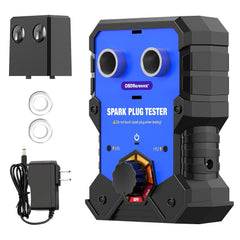
Spring-loaded test sockets and included spacers accommodate a variety of compatible plug bodies. Longer ceramic insulators may require one or two supplied spacers for correct positioning.
Simple Controls and Clear Status Indicators
A rotary control, main indicator, and two high-voltage indicators make operation straightforward. Indicator lights show operating status; they do not provide an automatic good-or-bad verdict.
100–240V AC Adapter Input
Power the tester using the supplied adapter and a compatible AC outlet. Test removed spark plugs on the workbench without connecting the tester to a vehicle battery.
Check Compatibility Before You Buy
- Measure the ceramic diameter. Use a caliper to measure the widest part of the ceramic insulator, including any raised ribs. The largest reading must be 13 mm or less.
- Compare the remaining dimensions. Check your existing spark plug against the tested samples below. Brand name or thread size alone does not confirm fitment.
- Check the exposed ceramic length. If it is longer than the F7TC reference sample or exceeds 35 mm, use one or two included spacers as needed.
- Confirm proper seating. The plug must seat securely, maintain electrical contact, and allow the protective cover to fit correctly. Never force a plug into the test socket.
Compatibility is based on dimensions, not brand. Spark plugs from any brand that match the listed compatible dimensions can be tested, provided the ceramic diameter, seating, and cover clearance meet the requirements. Measure your existing spark plug before purchasing.
Important: A ceramic diameter greater than 13 mm is incompatible. Adding spacers does not increase the test socket diameter.
Tested Spark Plug Compatibility
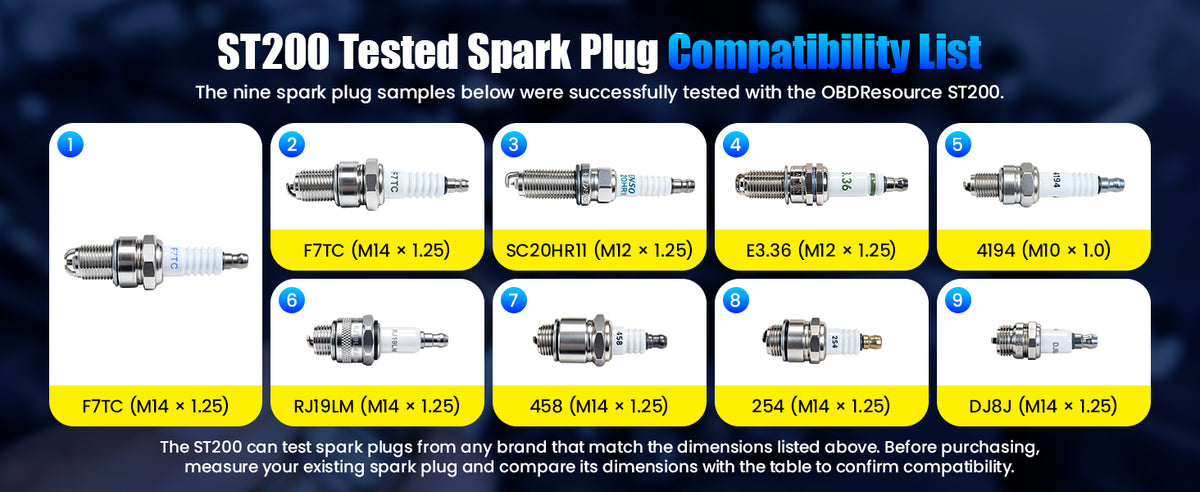
These nine samples have passed OBDResource ST200 fitment and testing. They are listed in the same left-to-right order as the reference lineup.
| No. | Brand / Model | Thread | Reach | Hex Size | Electrode / Type |
|---|---|---|---|---|---|
| 1 | F7TC — brand unconfirmed | M14 × 1.25 | 19 mm | 20.8 mm | Three ground electrodes |
| 2 | GL F7TC | M14 × 1.25 | 19 mm | 20.8 mm | Single ground electrode |
| 3 | DENSO SC20HR11 | M12 × 1.25 | 26.5 mm | 14 mm | Iridium; single ground electrode |
| 4 | E3 E3.36 | M12 × 1.25 | 19.05 mm (3/4 in) | 5/8 in (approx. 16 mm) | DiamondFIRE; fixed gap |
| 5 | Autolite 4194 | M10 × 1.0 | 12.7 mm (1/2 in) | 5/8 in (approx. 16 mm) | Copper core; single ground electrode |
| 6 | CHAMPION RJ19LM | M14 × 1.25 | 9.5 mm (3/8 in) | 13/16 in (approx. 20.6 mm) | Resistor; single ground electrode |
| 7 | Autolite 458 | M14 × 1.25 | 9.5 mm (3/8 in) | 13/16 in (approx. 20.6 mm) | Copper core; single ground electrode |
| 8 | Autolite 254 | M14 × 1.25 | 9.5 mm (3/8 in) | 3/4 in (approx. 19 mm) | Copper core; single ground electrode |
| 9 | CHAMPION DJ8J | M14 × 1.25 | Approx. 7.8 mm* | 5/8 in (approx. 16 mm) | Non-resistor; tapered seat |
*DJ8J reach is recorded as 0.307 in (approximately 7.8 mm) from the DJ-series specification; some listings state 8.3 mm. Verify the physical measurement when using this model for dimensional comparison. The tested DJ8J sample fits the ST200. Inch-to-millimeter conversions are approximate.
This table identifies tested examples, not every compatible spark plug. Matching thread size alone does not establish compatibility. Always check the maximum ceramic diameter and correct seating.
How to Use the ST200
- Prepare the tester. Switch it off and disconnect power. Use clean, dry spark plugs and work away from fuel and flammable vapors.
- Position the spark plugs. Fit compatible plugs into the test sockets. For comparison, use a known-good plug of the same specification as the suspect plug.
- Add spacers when needed. If the exposed ceramic section is longer than the F7TC reference sample or exceeds 35 mm, place one or two included spacers inside the ring-shaped insert, then insert the spark plug. Use the number needed for proper seating, electrical contact, and cover clearance.
- Install the protective cover. Check that it fits correctly before connecting the supplied adapter and switching on the tester.
- Adjust and observe. Turn the rotary knob to vary the firing frequency. Observe spark consistency through the magnifying windows.
- Switch off before handling. Disconnect power before removing, swapping, or repositioning either spark plug.
Understanding the result: The ST200 provides a visual bench test. It does not reproduce cylinder pressure, combustion temperature, or engine load. A plug that sparks on the bench may still fail in the engine. Use the result alongside the engine manufacturer’s diagnostic procedures.
Typical Applications
- Compare a suspect spark plug with a known-good reference plug.
- Observe intermittent firing or absence of spark during bench testing.
- Inspect firing behavior after spark plug cleaning or maintenance.
- Support spark plug checks during hard-start or rough-running diagnosis.
- Test dimensionally compatible plugs used in cars, motorcycles, ATVs, lawn mowers, generators, and other gasoline-powered equipment.
Technical Specifications
Model: ST200
Testing Capacity: Two spark plugs simultaneously
Control: Rotary firing-frequency adjustment
Simulated Speed Range: 0–6,000 RPM
Maximum Ceramic Outside Diameter: 13 mm per test socket
Viewing: Protective cover with magnifying windows
Fitment Adjustment: Spring-loaded sockets and included spacers
Power Adapter Input: 100–240V AC
Indicators: Main indicator and two high-voltage indicators
Application: Removed, dimensionally compatible gasoline-engine spark plugs
Frequently Asked Questions
How do I check whether my spark plug fits before purchasing?
Measure the maximum outside diameter of the ceramic insulator. It must be 13 mm or less. Then compare the remaining dimensions with the compatibility table and check whether spacers are needed for the exposed ceramic length.
Which part does the 13 mm limit apply to?
It applies to the ceramic insulator—the usually white section with the model number printed on it. Include raised ribs and measure the widest point. This limit does not refer to the metal threads or the hex used by a socket wrench.
How should I measure the ceramic diameter?
Use a vernier or digital caliper. Gently measure across several locations, including the smooth section and raised ribs. Record the largest reading, not just a measurement taken in a narrower groove.
Will a ceramic diameter of exactly 13 mm fit?
13 mm is the maximum supported diameter. Recheck measurements near the limit and confirm the other fitment requirements. Do not round a larger reading down: 13.2 mm, for example, exceeds the limit. Never force the plug into the socket.
What does M14 mean? Can an M14 spark plug fit?
M14 identifies a metric thread with a nominal outside diameter of 14 mm. It describes the lower metal threaded section, while the ST200’s 13 mm limit applies to the upper ceramic section. An M14 spark plug can fit when its ceramic diameter and other dimensions meet the requirements.
What do thread pitch, reach, and hex size mean?
- M14 × 1.25: A nominal thread diameter of 14 mm and a thread pitch of 1.25 mm. Pitch is the distance between adjacent thread crests, measured along the plug’s axis.
- Reach: The axial distance from the specified mounting-seat reference to the end of the threaded shell, excluding the protruding firing electrodes. Follow the plug manufacturer’s measurement diagram, particularly for tapered-seat designs.
- Hex Size: The distance across two opposite flat faces of the metal hex, used to select the correct socket wrench. It is not measured across the corners.
- Ceramic Insulator Length: The exposed upper ceramic section measured along the plug’s axis, excluding the top metal terminal and lower metal shell. It is not the overall spark plug length.
Can I test a ceramic insulator longer than 35 mm?
A longer ceramic insulator does not automatically make the plug incompatible. If it is longer than the F7TC reference sample or exceeds 35 mm, use one or two included spacers as needed. Place them inside the ring-shaped insert before inserting the plug. Correct seating, electrical contact, and protective-cover clearance must be maintained.
Can spacers make a ceramic diameter greater than 13 mm fit?
No. Spacers adjust seating height; they do not enlarge the test socket. A ceramic diameter greater than 13 mm remains incompatible.
Can I test brands or models that are not listed?
Yes, if their relevant dimensions match the compatible specifications and they seat correctly. The table shows tested examples. Compatibility is not limited to those brands, but brand name, similar appearance, or an M14 marking alone does not confirm fitment.
Does the ST200 test ignition coils or diesel glow plugs?
The ST200 is designed for removed gasoline-engine spark plugs. It is not a vehicle ignition-coil tester or a diesel glow-plug tester.
What should I provide if I am unsure about compatibility?
Please send the brand, complete model number, a photo of the entire spark plug, and caliper photos showing the maximum ceramic diameter and exposed ceramic length. Contact OBDResource support before purchasing if you need help checking fitment.
Use and Care
- Read and follow the supplied instruction manual.
- Keep the protective cover installed during operation.
- Never touch spark plugs or test contacts while the tester is powered.
- Disconnect power before adjusting, inserting, or removing plugs.
- Use clean, dry plugs and keep the work area free of fuel vapors.
- Keep the tester dry and never force oversized plugs into the sockets.
PRODUCT OWNERSHIP
Resources & Support
Find product documentation, available updates and technical help.