FEATURE HIGHLIGHTS
Core Capabilities

See It in Action
Video currently unavailable
The OBDResource BM210 Battery Monitor Gauge provides a clear, real-time display of battery voltage and remaining capacity. Designed for 12V–72V systems, it features a 10-segment LED bar, waterproof housing, ultra-low power consumption with auto sleep, and reverse polarity protection—ideal for golf carts, RVs, boats, forklifts, and battery-powered vehicles.
Real-Time Battery Level & Voltage Display
The BM210 battery gauge visually displays battery remaining capacity and voltage status using a bright LED bar, allowing quick checks without diagnostic tools or apps.
Wide Voltage Compatibility (12V–72V Systems)
Supports multiple battery systems including 12V / 24V / 36V / 48V / 60V / 72V, making it suitable for a wide range of vehicles and equipment.
10-Segment LED Bar Graph (Clear & Intuitive)
The 10-level LED display (typically green / yellow / red) shows battery status at a glance, helping users quickly determine whether charging or replacement is needed.
Waterproof & Vehicle-Grade Design
Built with a water-resistant housing, the BM210 is suitable for outdoor, automotive, and marine environments, offering reliable performance in daily use.
Ultra-Low Power Consumption with Auto Sleep
Designed to stay connected long-term without draining the battery. Auto sleep mode reduces standby power usage, ideal for stored or seasonal vehicles.
Reverse Polarity Protection
Built-in protection helps prevent damage from incorrect wiring, improving installation safety and product reliability.
PRODUCT OWNERSHIP
Resources & Support
Find product documentation, available updates and technical help.


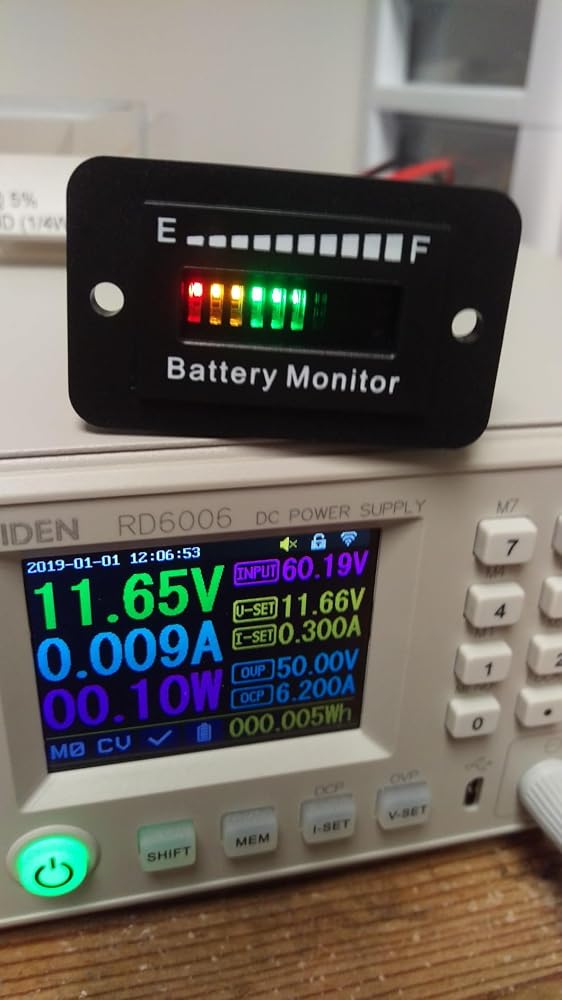
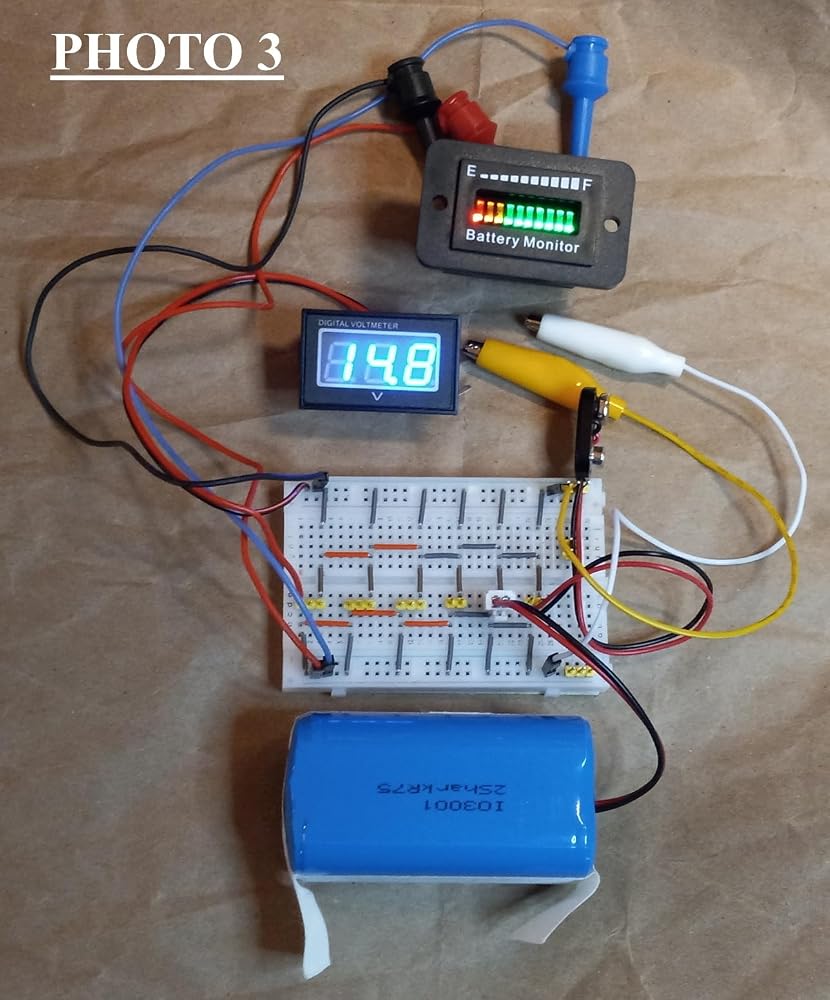
I own several types of batteries and each of those types have different characteristics. When I saw this LED battery monitor/gauge/indicator for both lead-acid and Li-ion batteries, that was offered by the OBDResource Store, I was somewhat confused due to the different charge/discharge curves and ranges, for those two chemistries, and curious as to the voltage “turn-on points” for each of the R-Y-G bars. I wanted to try one of these on several other battery types that are not “multiples of 12V” and “out of range” voltages. I made a request and Amazon delivered it four days later.PHOTO 1: It’s physically a clean looking, simple panel mount meter that has a fairly bright LED display. If you’ve looked over the advertisement you will know that there are three switches that are placed into ON or OFF positions to obtain the voltage range that matches the voltage range of the battery. I set it to 12V.PHOTO 2: The fourth green LED had just turned on at 11.7V. I measured the turn-on voltages for each of the nine bars, not counting red, it stays on. Knowing these voltage levels,PHOTO 3: Although advertised as “LED battery monitor/gauge/indicator for both lead-acid and Li-ion batteries”, I found that in the higher Li-ion range, where 14.8V OCV to 13.6V “dead battery”, turns on all of the green LEDs. At 12V, when the battery turns off, the meter will have five greens turned on. I should be able to use two resistors to build a voltage divider circuit to fit the higher Li-ion range of ≤13.6 to ≥14.8V, into the 10.7V (first yellow-on) to 12.8V (last green-on) range of the meter.PHOTO 4: I tried this 40V battery pack with the meter set for the 48V range, but 41V is too low so,PHOTO 5: I tried it with the meter set to the 36V, but of course, 41V is too high and pegs the greens. This time, a different combination of resistors will be used to bring the 41V range of the battery down to the 36V range of the meter.A sharp looking, panel mount, bar-type voltage meter with ranges based on 12V Lead-Acid batteries, for use in battery powered golf carts or internal combustion engine driven vehicles. I believe I can modify the range to be whatever range I need. I sure hope so, this is one of three.I thank the OBDResource Store for making this available and Amazon fir the quick delivery.



This came with everything pictured (connectors, screws, nuts and module). Tested it with my variable power supply and it's not exactly accurate for 12v range, but does get more accurate getting closer to 36v. In order to get exactly 12.0v on this module, I had to set my output to ~12.16v. This is ~1% tolerance, so I'd say it's acceptable for most electrical components and not really a big deal. However, in the instruction manual that was included, it specifically says +/- 0.5% tolerance, which in that case is a lie, so deducting 1-star. My power supply only goes up to 32v, so for that setting this was reading 31.9 at that time.At time of purchase, this was about $20. I'd say that's a decent value, however since it can be set for multiple voltage readings and switch between charge percentage, i think it's actually a good price since it's more versatile.Per the included instructions, which were actually well written and easy to understand, if you hold the setting button for a 3-seconds, you can switch between the listed voltages (12-72) this is useful if you want to use the percentage display vs the voltage display. I prefer the voltage display, but you do you.I will be using this for a remote controlled rover that I've built.Oh, by the way if you need metric measurements for the cut-out-hole to use (which I also prefer), at minimum use 24.5mm height by 36.5mm wide. Screw holes are about 43.75mm center to center. Overall dimensions: 53.5mm wide by 32.5mm height.Lastly, this does look decently sealed overall, but I would not believe their "waterproof" promise. I gentry tried prying the faceplate open and it came came off fairly easy. Looks like they used acetone drops or similar liquid to melt/weld it on 4 corners. If you intend to use it outdoors, probably not the best choice, even though the inside still looks acceptable for water-resistant vs "waterproof".


Nice item works well


Going to mount this in the battery box for my small boat. Nice and bright and comes with 2 mounting screws and 4 terminals.Easy wiring


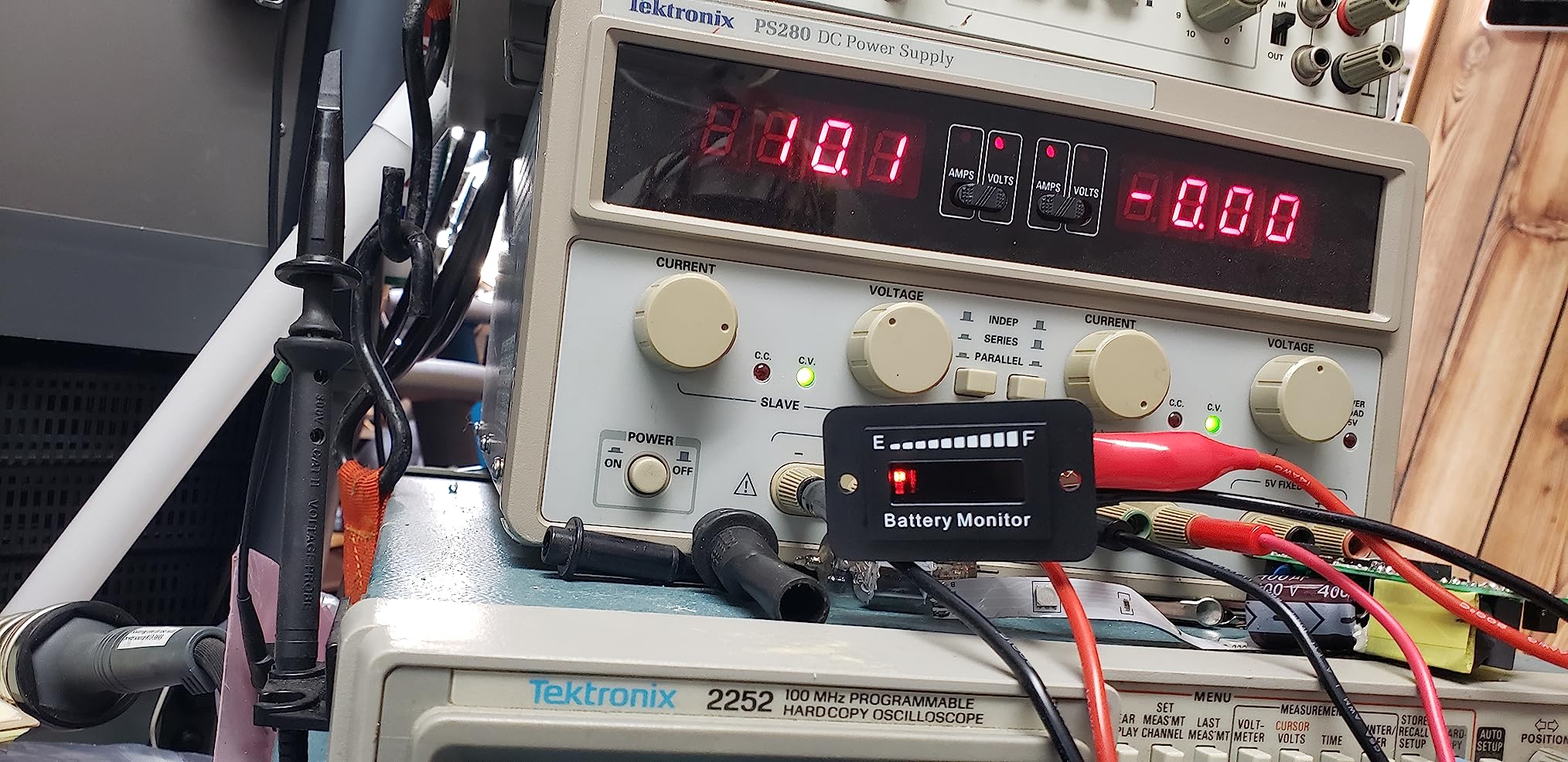
I checked this out on a variable power supply. At 10 volts only one led is on,means your battery is about dead you never want to run a lead acid or gelcell that low or you will shorten life of battery tremendously.. Meter is pretty good at showing voltage. It would be nice if it would flash when your charging system went over 14.8 volts showing you have a failed charging system,oh well just a thought.


Our meter went out the first replacement only lasted a week (different brand). This one looked much better out of the box. The plastic housing was not cracked and is smooth. The metal prongs are sturdy and aligned correctly. Install was a breeze; the gauge was up and running immediately, and we have had no issues. Recommend if yours goes out; we have a Polaris Cart.


This is great for solar and pocket bikes.

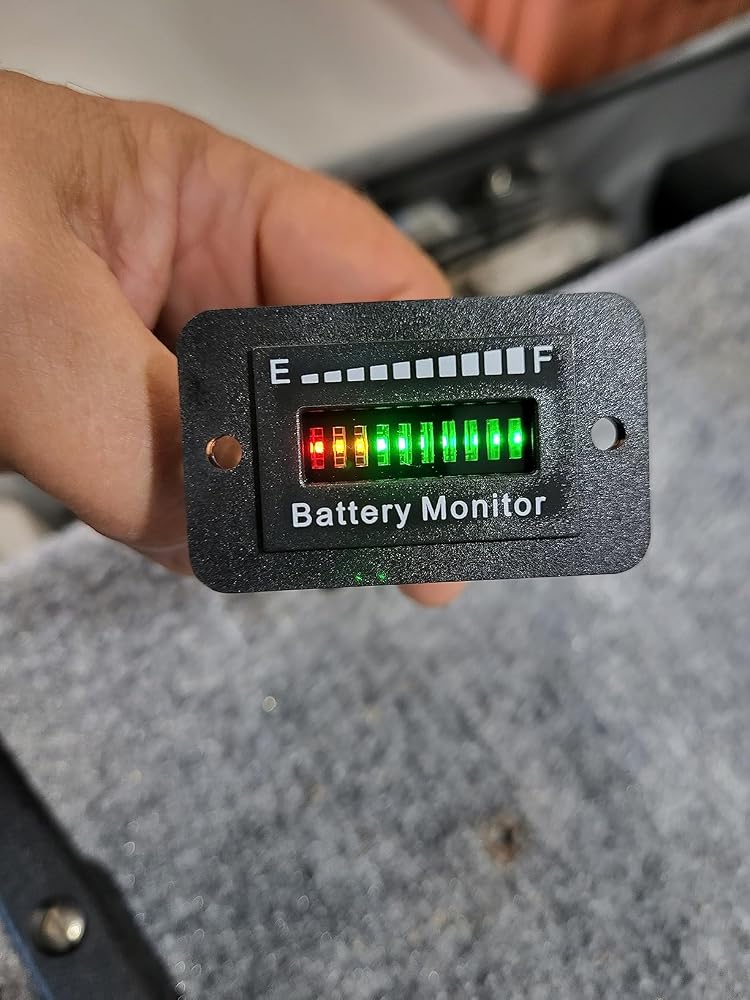
This works for 12v, 24v, 36v, 48v, 60, and 72v. The specific level to measure is selectable by 3 dip switches underneath a round rubber plug.It's a very bright display. So, when I connected it to a 12v battery to test, I took it outside and it's still a bright display. I included a picture of it lit up outside.It comes with connectors to soldered or crimped unto wires. It has 3 terminals with the 3rd terminal being used to turn on the display. If you want the display to always be on, you just wire two of the terminals together. The instruction sheet has diagrams of the wiring options and the dip switches.


Exactly as advertised

Easy to. Install. Works great.

I am very pleased and happy with this product. I have purchased one similar to this and upon receiving it it did not work at all and then I requested it for another one that did not work, so I finally decided to go with this one and this brand, and it works like a charm as should.Great pick!!

Much easier to see my battery levels now. Easy to install, too.

The meter has not be activated because I am concerned about wiring area behind my old Murray tractor. This looks to be well made electrically. Good solid solders. Very good quality fittings. Good instructions.I should have looked before ordering for a mounting plan B. It's an old tractor and a external mounting box would be fine but I can not find one to fit it and then I could glue or whatever it to the dash. If I can't get it to fit in the hole I have my backup plan was not well thought out. There are many round external mounts so that may be what I end up with. Just be aware that you must have enough room behind your gauge also, if not you are not going to enjoy your meter. They give you measurements but don't show the extra room needed on backside. I figured I would just order a mount, I could not find one to buy


I installed this gauge on an e-bike which uses two Milwaukee 18 volt li-ion batteries hooked in series to power a 36 volt hub motor. I'm not sure of the exact reason for it but the gauge seems to provide some erratic and misleading readings. For example, when under load the gauge sometimes appears to give fairly accurate readings (as compared to my own measurements using a multimeter and the built in LED's on each battery. At other times, however, the readings are way high. For example during one trip the reading on the gauge while under load showed 9 bars (out of 10) while the LEDs on the batteries themselves showed just two bars (out of 4). So the gauge showed nearly full voltage while the batteries themselves showed they were at half voltage. Just a few minutes before that, however, the gauge, while under load, had show just 6 bars which was probably fairly accurate when compared to the LEDs on the battery. On a different occasion I finished a ride and the gauge was showing 8 bars. The battery LED's showed 2 bars. And when I checked he voltage with a multimeter it showed just a hair under 18 volts in each battery (which would be what I consider "half empty" since a full charge shows a bit over 20 volts and the "safety zone" for going under voltage is 16 volts. So 18 volts is the midway point in the charge range. I was hoping this gauge could give me some peace of mind and provide a warning whenever I might be close to being under voltage or, God forbid, getting close to possibly bricking my batteries. Unfortunately I am finding the gauge to be somewhat erratic and inaccurate. I do have the dip switches set to 36 volts so I don't believe that is an issue. For all I now maybe it has something to do with reading two batteries wired in series. But whatever the reason, this gauge is not the answer for my needs.


Good and easy to use!

Installed this in my 2008 EZGO golf cart in less than 15 minutes. Looks sharp and clean compared to the original gauge which was just an orange color with fewer steps in the gauge. Hopefully this last a long time. Accuracy seems to be fairly good but I’ve not driven the batter down past 50% yet. Nice update for an older cart.


Overall the monitor does what it's supposed to. But, I feel the voltage chart is a little confusing. Basically the voltage that the chart shows under a particular LED count appears to be 1 LED count off. I used a highly precise power supply to do my measurements which you can see in the pictures. In the chart provided in the manual, it shows for 6 LEDs at a voltage of 11.43V - what I observed was at 11.42V I would get 4 LEDs and at 11.43V I would get 5 (not the 6 I thought I should get). Although quite accurate in the voltage level transition point on the chart, the LED count as I said appears minus 1 off.Being 1 off on the LED count could be of concern for some since what I also found was to get all 10 LEDs to light up I needed ~12.68V and not the >12.30V that the chart implied. I think all 12V batteries can be safely charged up to 12.70V so this probably isn't of concern, but showing on the chart that it should have all 10 LEDs on at >12.30V is slightly misleading (at that voltage only 9 LEDs are on). I didn't test the higher voltage settings (i.e. 24V, 36V, 48V) but I would assume that the ratio of difference is probably identical. Because of this I would recommend you test the higher voltage systems to get an idea of exactly the voltage all 10 LEDs light up. In my quick test I just used a wire shunt between the V+ terminal and the control terminal.One of my pictures shows that at 12.68V the LED count can fluctuate between 9 and 10. At 12.70V it was stable at the 10 LEDs. It does take around 10 seconds for updates to occur. When all 10 LEDs are on, the device consumes around 11mA. This could've been slightly less if the manufacturer was willing to dim the LEDs some. They did set it up such that the installation of a switch between the V+ and the control terminal will make the device consume 0mA of power. If you have this on a car battery rated at say 40Ah it would take around 200 days of constantly running to eventually ruin your battery (if you didn't charge it at all). If you have a 100Ah deep cycle battery you are looking at a year. So I don't think the 11mA load is sufficient to be of concern, but having a switch on it would eliminate that entirely.The price is a little high considering you just have LEDs lighting up and not actual values like some monitors do. But, on the other hand some of those digital display monitors consume far more than 11mA to run and therefore your use of the device and how often you keep your system charged will need to be part of that decision.I subtracted a star on value for money since a slightly lower price would make this more economical considering this is just an LED bar display. And I also subtracted a star on Accuracy because the values in the chart did not seem to align with the number of LEDs that should've been on. Since the voltage values did match spot on for the transition points, just not the LED count...the device is still quite useable as long as you know this minus 1 LED count offset.Overall I think it could be useful to many people who need a simple battery monitor and if hooked up with a switch it won't impact the batteries at all when turned off. If you need something more complex like actual voltage values or maybe some type of Bluetooth/Wi-Fi capability and you are NOT concerned with the additional power draw these devices have, then maybe one of those types would be better suited for you.